

Beschrijving
Mokhai is an open-source WordPress plugin that turns your site into a first-class citizen of the AI-agent web — readable today, actionable next. A single Context Profile (configured once under Tools Context) is the source of truth for every agent-facing surface — what’s exposed, how it’s served, and how it’s scored.
Mokhai ships seven coherent modules, all driven by one Context Profile:
- Markdown Views — deterministic HTML Markdown rendering for any public URL, with three URL forms (
.mdpath,?format=mdquery,Accept: text/markdowncontent negotiation) and uniform 404 on denial. Per-post cache with content-hash invalidation, Gutenberg sidebar preview, WP-CLI command, REST endpoint for admin tooling. - LLMs Index —
/llms.txtgenerator that publishes a discovery surface for AI agents, with conflict detection againstrobots.txt, an editorial entries admin UI for site owners to add curated entries, and an optional LLM-powered pass that drafts entry descriptions from post content. - Context Score — 0–100 readiness audit across seven weighted sub-scores (discoverability, description coverage, schema coverage, exposure safety, integration health, Markdown conversion quality, multi-channel discovery), surfaced in an admin page, Site Health, and
wp mokhai context-score recompute. Includes an optional LLM-generated narrative (with a rule-based fallback) explaining the score and the highest-leverage fixes. - Schema Coordination — detects whether your SEO plugin already emits JSON-LD; if not, optionally emits a native WebSite + Organization + per-content schema set so the schema sub-score is achievable without a third-party SEO plugin. Defers gracefully when an SEO plugin is already covering the surface.
- AI Assistant Preview — an admin pane that shows any post exactly as an AI assistant consumes it: raw HTML, the Markdown View, and the live
/llms.txtline side by side, plus an on-demand “sample AI summary” so you can sanity-check what an agent would say about the page. - Agent Abilities + MCP — exposes core plugin operations (audit run, profile read, exposure toggle,
/llms.txtregenerate, Markdown preview) through the WordPress Abilities API, and surfaces them to MCP clients via the WordPress MCP adapter. Every ability ismanage_options-gated. - Multi-channel discovery — a seventh Context Score sub-score crediting additional agent-discovery surfaces (
ai.txt,/.well-known/declarations, OpenAPI) beyond/llms.txt, so a site running several discovery channels scores higher than one running only one.
The plugin is fully free, GPL-2.0+, with no paid tier and no hosted backend. Every module is independently toggleable from the Context Profile. No content leaves your server. The plugin makes no external HTTP calls; AI providers configured via the WP AI Client (an optional dependency) are only consulted by modules that explicitly opt in, and every deterministic surface (Markdown Views, /llms.txt, the rule-based score, the gap-fill schema) runs fully locally without an AI provider.
Markdown Views
Markdown Views exposes any public URL as a clean Markdown variant. The intended consumer is an AI agent that’s discovered a URL (typically via /llms.txt) and wants the raw content without HTML chrome, header/footer/sidebar markup, or JavaScript-rendered widgets.
Three URL forms
All three return the same body. Pick whichever matches your client.
https://example.com/about-us.md— path-form (requires pretty permalinks; aligned with the llms.txt ecosystem convention)https://example.com/about-us/?format=md— query-form (works regardless of permalink structure)Accept: text/markdownheader on the canonical URL — content-negotiation form
The 200 response always carries Content-Type: text/markdown; charset=utf-8, X-Robots-Tag: noindex (so search engines don’t index the raw view as a duplicate of the HTML), and Cache-Control: no-store, must-revalidate.
Exposure rules
A URL returns 404 with no body — never a partial content leak — when any of the following is true:
- The post’s CPT is not in the Context Profile’s “Exposed CPTs” list
- The post’s status is not in the “Exposed statuses” list (defaults to
publishonly) - The post is password-protected
- The
mokhai_post_is_noindexedfilter returns true (Mokhai auto-detects per-post noindex from Yoast, Rank Math, and AIOSEO and drops the post from agent surfaces;mokhai_post_is_noindexedis the extension point for additional sources) - The Markdown Views module is toggled off in the Context Profile
All denial paths produce the same 404 shape — admin debugging via the REST endpoint or the wp mokhai md preview command surfaces the specific reason.
Inspection surfaces
- Gutenberg sidebar panel — opens automatically in the document settings sidebar when editing a post. Shows the current MD rendering, the visibility verdict, and the cache state (cached vs miss, walker version, generated_at).
- WP-CLI —
wp mokhai md preview <post-id-or-url>. Supports--format=wrappedfor YAML-front-matter output suitable for piping into LLM tooling,--show-metafor cache diagnostics on stderr, and--bypass-exposure(requires manage_options) for inspecting hidden posts without serving them. - REST endpoint —
GET /wp-json/mokhai/v1/markdown-views/preview?post=<id>. Authentication via WP cookie / nonce; permission gated onedit_postfor the target post. Used by the Gutenberg sidebar; available to third-party admin tooling.
LLMs Index (/llms.txt)
Mokhai publishes a /llms.txt discovery surface for AI agents — the de-facto convention for declaring which URLs on a site are worth fetching as agent context. The generator is driven by the Context Profile: only CPTs and statuses you’ve exposed appear in the index. Conflict detection surfaces when robots.txt already covers the same paths; an admin notice points to the conflict so coverage isn’t silently inconsistent.
Editorial entries
Most sites have URLs that aren’t WordPress posts but are valuable agent context — pricing pages, brand guidelines, support knowledge bases hosted elsewhere. The editorial entries admin UI lets site owners add curated entries with custom titles and descriptions; they appear in /llms.txt alongside the auto-generated post entries.
LLM-powered descriptions
Optionally, an LLM pass drafts the per-entry descriptions from the post content (uses the WP AI Client provider configured at the site level). The deterministic floor — title-only, no description — runs without an AI provider.
Posts whose body is below a minimum length are skipped by the LLM pass rather than padded with filler (e.g. a bare “Title is available at URL.”). Such entries show a “skipped” status in the Descriptions tab and fall back to the title-only floor in /llms.txt. Adjust the threshold with the mokhai_description_min_content_chars filter.
WP-CLI
wp mokhai llms-txt status— current generation state, conflict report, entry countwp mokhai llms-txt regen— force regenerationwp mokhai llms-txt preview— output the current/llms.txtcontent to stdout
Context Score
Context Score is the 0–100 readiness audit answering “how prepared is this site for AI agent traffic?”. It combines seven weighted sub-scores:
- Discoverability (weight 10) —
/llms.txtcache populated, at least one CPT exposed, entries published, no rewrite conflicts overriding the route - Description coverage (weight 15) — share of exposed entries that have a curated description (post excerpt or LLM-generated cache from the descriptions module)
- Schema coverage (weight 10) — JSON-LD is being emitted, either by a detected SEO plugin (Yoast / Rank Math / AIOSEO / The SEO Framework) or by Mokhai’s native gap-fill emitter when the Context Profile toggle is on
- Exposure safety (weight 15) — exposed statuses are limited to
publish(no risky non-publish exposures) and at least one CPT is configured explicitly rather than implicitly - Integration health (weight 15) — LLM features AI Client posture are consistent (no silent-degrade trap) and no
/llms.txtconflicts are unresolved - Markdown conversion quality (weight 25) — mean quality score across the Markdown Views cache and the percentage of cached posts above the cleanup threshold
- Multi-channel discovery (weight 10) — how many of the four plugin-served agent-discovery surfaces are present (
/llms.txt,ai.txt,/.well-known/ai-layer,/.well-known/llms-policy.json); all four = 100, so a plugin-only site can reach full marks. OpenAPI is detected and credited as a bonus channel for sites exposing an API but does not change the score. Sibling-provider plugins (e.g. AI Layer) are detected and credited via the filterablemokhai_multi_channel_providersregistry.
The score is surfaced in three places:
- Tools Context Context Score — the full breakdown with per-sub-score detail
- Site Health — the headline score and the highest-leverage area to improve
- WP-CLI —
wp mokhai context-score recomputefor scripted audits
An LLM-generated narrative (uses the WP AI Client provider) explains the score in plain English and names the highest-leverage fixes. A rule-based narrative ships as a fallback for sites without an AI provider configured.
Schema Coordination
When you have an SEO plugin (Yoast, Rank Math, AIOSEO, The SEO Framework) active and emitting JSON-LD, Mokhai defers schema emission to them entirely — no competing markup, no duplicate type declarations. When no SEO plugin is emitting schema, Mokhai can optionally emit a native WebSite + Organization + per-content schema set so the schema sub-score in Context Score is achievable without a third-party SEO plugin. The toggle lives in the Context Profile; default is off (gap-fill behaviour kicks in only when explicitly enabled).
AI Assistant Preview
The AI Assistant Preview pane (Tools Context) answers a question every site owner eventually asks: “what does an AI assistant actually see when it reads this page?” Pick any exposed URL and the pane renders three views side by side — the raw HTML, the Markdown View an agent fetches (proxied through the same converter as the live .md surface, so the no-hallucination guard applies), and the exact /llms.txt line for that entry. A “Sample AI Summary” box generates an on-demand, synchronous summary using the configured WP AI Client provider (no cron, no background queue — it runs and caches in place), so you can sanity-check the agent’s-eye view of a page before publishing. The summary degrades gracefully (a structured hint, never a raw error) when no AI provider is configured.
Agent Abilities (MCP)
Mokhai registers a mokhai ability category and five core WordPress Abilities (WP 6.9+): audit-run, profile-read, profile-set-exposure, llms-txt-regenerate, and md-view-preview. Each is a thin wrapper over an existing service, gated on manage_options, and exposed via the core wp-abilities/v1 REST surface. When the WordPress MCP adapter is installed, these abilities are also reachable by MCP clients (the abilities are flagged meta.mcp.public), making the plugin’s operations callable by agent runtimes — a step from agent-readable toward agent-usable. The MCP flag is inert when no adapter is present, so the abilities work standalone.
Privacy and Storage
Mokhai stores rendered Markdown in a custom table named {$wpdb->prefix}mokhai_md_cache, with one row per published post that has been requested at least once as Markdown — holding the Markdown body, an integrity hash of the source content, and the timestamp at which it was generated. The cache is invalidated automatically when a post is saved, trashed, or deleted.
Context Score audit results are cached in the mokhai_context_score_cache wp_options entry (the most-recent breakdown only — overwritten on each recompute).
No content leaves your server. The plugin makes no external HTTP calls and ships no third-party analytics. AI providers configured via the WP AI Client (an optional dependency) are only consulted by modules that explicitly opt in; the deterministic surfaces (Markdown Views, /llms.txt, rule-based score narrative, gap-fill schema) all run fully locally without an AI provider.
Both cache tables are dropped on plugin uninstall (not on deactivation — deactivate is reversible, uninstall is the explicit “I’m done” gesture).
Configuration
Under Tools Context, set:
- Exposed CPTs — the list of post types to expose to agents. Default: empty (safe-by-default — a fresh install exposes nothing).
- Exposed statuses — the list of post statuses to expose. Default:
publishonly.
The same screen exposes the LLM cleanup toggle (Markdown Views auto-cleanup pass), the LLM descriptions toggle (auto-drafted /llms.txt entry descriptions), and the native Schema emission toggle (default off — opt in to satisfy Context Score’s schema sub-score without a third-party SEO plugin). Each toggle gracefully degrades when the WP AI Client is unconfigured.
To turn Markdown Views off without uninstalling:
wp eval "$p = get_option('mokhai_context_profile'); $p['markdown_views_enabled'] = false; update_option('mokhai_context_profile', $p);"
The module respects the toggle without latency — flipping back to true is instant; the cache table is preserved across toggle cycles.
Schermafbeeldingen

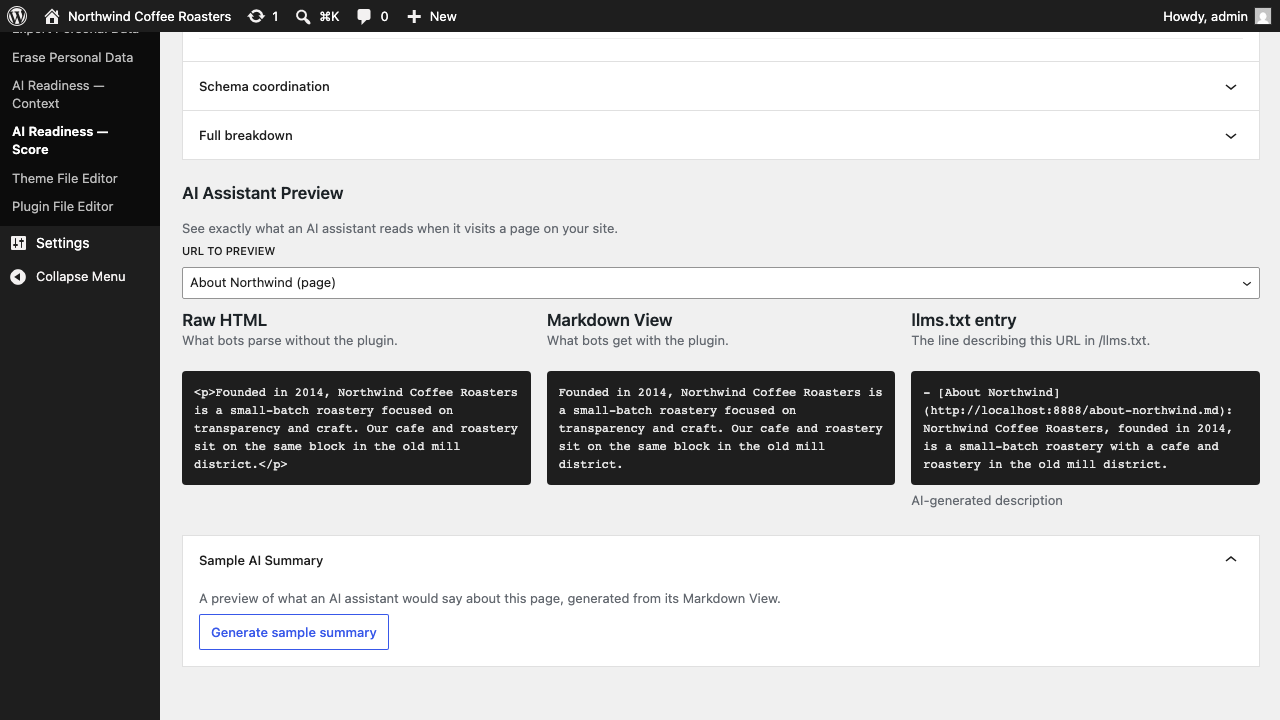
/llms.txt line, side by side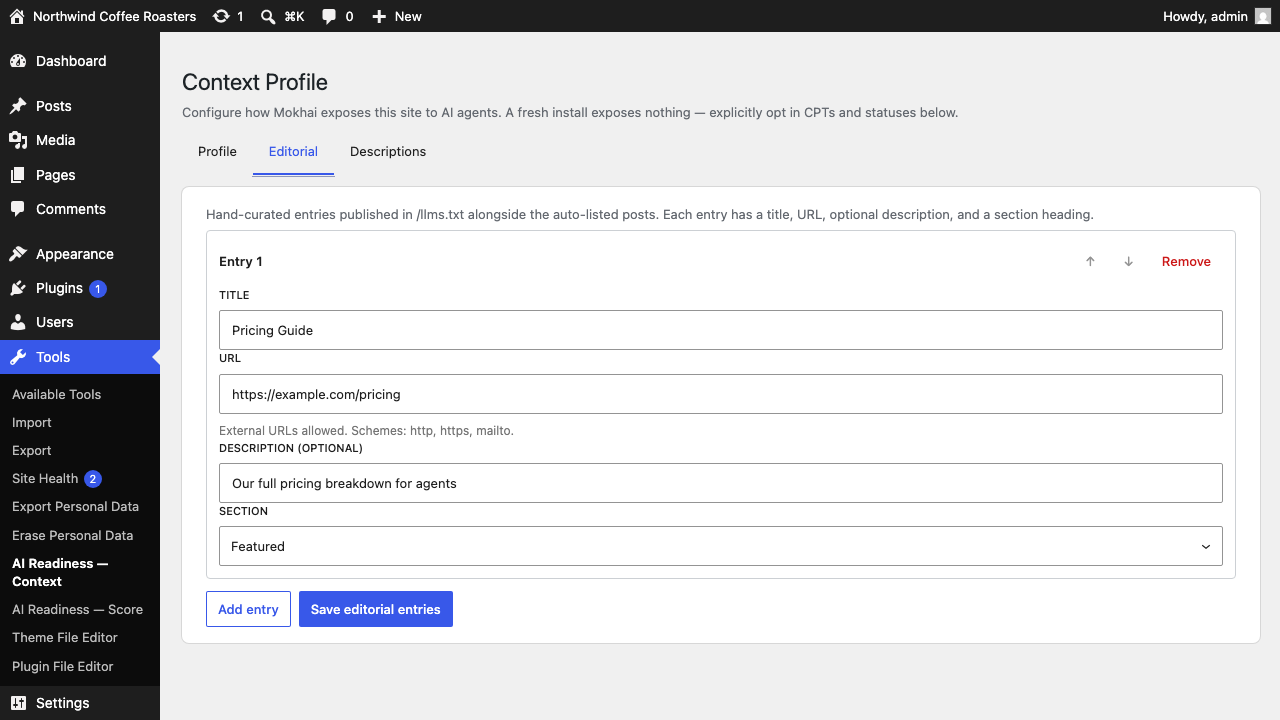
/llms.txt admin UI with editorial entries and LLM-powered descriptions
FAQ
What is llms.txt and why should I care?
AI assistants like ChatGPT, Claude, and Perplexity increasingly visit websites to answer questions for their users. Most WordPress themes serve them the same heavy HTML built for humans — menus, sliders, widgets — and the actual content gets lost in the noise.
llms.txtis a simple convention: a plain-text file at your site’s root (likerobots.txt, but for content) that tells AI assistants what your site is about and where to find your best pages. Mokhai generates and maintains it for you, alongside clean Markdown versions of your pages that agents can actually read. If AI assistants are answering questions in your topic area, this determines whether your site is the source they cite — or the one they skip.Does Mokhai require an AI API key?
No. Every deterministic surface (Markdown Views, /llms.txt floor, rule-based Context Score narrative, gap-fill JSON-LD emission) runs fully locally with no external calls. Modules that benefit from an LLM (the Markdown cleanup pass, /llms.txt entry-description drafting, the LLM-narrated Context Score) require the optional WP AI Client to be configured, but each is independently toggleable and not load-bearing for the core agent-readiness contract.
How does Mokhai interact with my SEO plugin?
For JSON-LD: when an SEO plugin (Yoast, Rank Math, AIOSEO, The SEO Framework) is active, Mokhai emits nothing competing — schema is theirs. When no SEO plugin is emitting JSON-LD, you can optionally enable Mokhai’s native gap-fill emission from the Context Profile. For noindex: Mokhai auto-detects per-post noindex from Yoast, Rank Math, and AIOSEO and drops the post from agent surfaces. Use the
mokhai_post_is_noindexedfilter to add support for additional sources.How is this different from existing /llms.txt plugins?
/llms.txt is one surface among several. Mokhai ships the integrated reading layer (Markdown views), the discovery layer (/llms.txt with editorial entries and LLM-powered descriptions), the audit layer (Context Score across seven sub-scores), and the schema coordination layer as a single coherent unit driven by one Context Profile. Most existing plugins target one of these surfaces in isolation; Mokhai treats them as a coordinated stack.
What’s on the roadmap?
v0.5.0 is the public-launch baseline: Markdown Views,
/llms.txt, the Context Score, the AI Assistant Preview pane, and the WordPress Abilities API + MCP integration. Looking ahead: agent-activity analytics (see which AI agents visit your site, not just optimize for them), a fuller agent-actionable layer (callable tools via WebMCP /navigator.modelContext), and a richer/.well-known/llms-policy.jsonpolicy-declaration surface.
Beoordelingen
Er zijn geen beoordelingen voor deze plugin.
Bijdragers & ontwikkelaars
“Mokhai – Agent Readiness Kit” is open source software. De volgende personen hebben bijgedragen aan deze plugin.
Bijdragers
Vertaal “Mokhai – Agent Readiness Kit” in je eigen taal.
Interesse in ontwikkeling?
Bekijk de code, haal de SVN repository op, of abonneer je op het ontwikkellog via RSS.
Changelog
0.5.0 — 2026-06-30
Public-launch baseline. This is the first release where every developer-facing and end-user-facing identifier aligns under the mokhai scheme. No new features ship in this release.
- Identifier rename — internal scheme — the PHP namespace (
Mokhai\), WP-CLI root (wp mokhai), REST namespace (mokhai/v1), WordPress Abilities category (mokhai), option/meta/table keys (mokhai_*), and all hook names (mokhai_*) now match the plugin’s public name. The previousai-readiness-kit,agentready, andai_readiness_kitidentifiers are gone. - NO automatic migration — option keys, post meta, and the Markdown cache table were all stored under
agentready_*orai_readiness_kit_*names in releases prior to 0.5.0. A pre-0.5.0 install re-initialises its settings on first page-load after upgrade; re-configure the Context Profile under Tools Context (Exposed CPTs, Exposed statuses, and toggles). The Markdown cache rebuilds on demand from the first request to each.mdURL. - Branding — refreshed Plugin Directory icon and banner assets align with the Mokhai identity established in 0.3.2.
0.4.0 — 2026-06-29
Public-launch release. The plugin is now live on the WordPress.org Plugin Directory as “Mokhai – Agent Readiness Kit” (slug mokhai-agent-readiness-kit). This release is launch housekeeping — no functional change, no migration:
- Refreshed Plugin Directory assets — new banner, icon, and screenshots.
- Polished readme copy for the public listing.
- Repository links consolidated under the
mokhai-agent-readiness-kitname (Plugin URI, package metadata). REST routes, WP-CLI commands, abilities, option keys, and all stored data are unchanged — existing installs upgrade in place with no action required.
0.3.2 — 2026-06-21
Rename to “Mokhai – Agent Readiness Kit” (text domain mokhai-agent-readiness-kit). wp.org plugin review rejected “Agentable” as colliding with existing third-party projects and required a name and slug that are clearly ours, with a distinctive leading term. “Mokhai” satisfies that. REST, WP-CLI, abilities, option keys, and all stored data are unchanged — existing installs upgrade with no migration. (#259)
Also ships the following changes that landed on main since 0.3.1:
/llms.txtnow warns in the admin when a staticrobots.txtblocks the/llms.txtreference, so the conflict isn’t silent. (#245, #250)/llms.txtemits the site header on an otherwise-empty index instead of returning a blank body. (#244, #249)- WooCommerce transactional pages (cart, checkout, account) are now excluded from the
/llms.txtindex. (#243, #248) - Markdown Views falls back to the raw
post_titlewhen a filtered title comes back empty, so titled posts no longer render untitled. (#242, #247) - Markdown URL mapper now guards the root / front-page URL, fixing mapping on the home route. (#241, #246)
0.3.1 — 2026-06-14
Rename to Agentable (text domain agentable). The previous “AgentReady” brand collided with an existing third party (agentready.org), so the plugin is renamed to a distinct, ownable name that also fits the roadmap — sites readable today, actionable next. REST, WP-CLI, abilities, and stored data keys are unchanged, so existing installs upgrade with no migration. Also makes root-served-file detection (llms.txt, ai.txt, .well-known/*) subdirectory-install aware via get_home_path() instead of assuming the install root is the web root. (#230)
0.3.0 — 2026-06-12
Polish release. Refinements surfaced through a full live UX walkthrough of the v0.2.0 admin surfaces — score-narrative correctness, clearer labels, and a more discoverable plugin. Also renamed to “AgentReady – AI Readiness Kit”; REST, WP-CLI, and stored data keys are unchanged. (#224)
Improved
- Multi-channel discovery is reachable at 100 for plugin-only sites — the four plugin-served discovery channels (
/llms.txt,ai.txt,/.well-known/ai-layer,/.well-known/llms-policy.json) now score 100 on their own; OpenAPI is credited as a bonus channel for API-exposing sites rather than capping the score at 80. (#212) - “Content readability” renamed to “Description coverage” across the Context Score page, Site Health, and readme, to match what the sub-score actually measures (curated
/llms.txtdescription coverage). Internal key unchanged. (#211) - Plugin is now findable in wp-admin — the Tools entries read “AI Readiness — Context” / “AI Readiness — Score”, and the Plugins list carries a “Settings” link to the Context Profile. (#207)
- Quality floor for auto-descriptions — near-empty posts are skipped (distinct “skipped” status) instead of padded with filler like “Title is available at URL.”; threshold filterable via
agentready_description_min_content_chars. (#214)
Fixes
- Schema-coverage narrative no longer reads “No structured data was detected” beside a 100/100 score when native JSON-LD emission is on; the stale “future release” fix advice is replaced with the reachable Context Profile action. (#208)
- Content-readability fix advice now points to the Descriptions tab “Regenerate stale descriptions” GUI path and stops telling users to enable a setting that is already on. (#209)
- The multi-channel discovery sub-score renders a human label instead of the raw
multi_channel_discoverykey. (#210) - AI Assistant Preview shows an explicit “no content” message for empty posts instead of blank dark panes. (#213)
- Relative-time copy uses proper
_n()plural forms (“1 minute ago” / “5 minutes ago”); excluded posts in the Descriptions table are labelled “excluded” and the intro copy matches. (#215)
0.2.0 — 2026-06-03
Feature release. Three new agent-facing modules plus a batch of correctness fixes surfaced through live testing.
New
- AI Assistant Preview pane — view any post as an AI assistant consumes it (raw HTML / Markdown View / live
/llms.txtline, side by side) with an on-demand synchronous “sample AI summary”. No cron; degrades gracefully without an AI provider. (#45) - WordPress Abilities API + MCP — five
manage_options-gated abilities (audit-run, profile-read, profile-set-exposure, llms-txt-regenerate, md-view-preview) exposed via corewp-abilities/v1, and reachable by MCP clients through the WordPress MCP adapter when installed. (#21, #131) - Multi-channel discovery sub-score — Context Score gains a seventh sub-score crediting agent-discovery surfaces beyond
/llms.txt(ai.txt,/.well-known/declarations, OpenAPI), with a filterable sibling-provider registry. Discoverability re-weighted 20 10 to fund it; total stays 100. (#22)
Improved
- Tools Context rebuilt as a single Card + TabPanel single-page admin, aligned with the WP AI Client / OpenAI Connector design system, with REST write controllers for the Context Profile and editorial entries. (#142)
- Context Score reason strings are now fully translatable via reason codes, and the sub-score copy across the admin UI and the LLM narrative prompt derives from a single source of truth (
Engine::WEIGHTS). (#137, #139, #140)
Fixes
- JSON-LD is now emitted without
esc_html()(angle brackets escaped viaJSON_HEX_TAG), so the structured-data payload validates in every standards-compliant validator. (#118) - Stale past-timestamp cron events are cleared before re-scheduling across all four schedulers (
/llms.txtrecompute, Context Score recompute, Markdown cleanup, description generation) — fixes “stuck pending forever” on sites where wp-cron sat stale. (#115, #120, #121) - The Markdown cleanup allowlist now preserves word boundaries at block edges, so headings and paragraphs adjacent to block tags are no longer dropped by the no-hallucination guard. (#135)
- Orphaned shortcodes are stripped from both the deterministic Markdown walker and
/llms.txtentry descriptions via a shared helper. (#145, #147) /llms.txtnow recomposes when a post’s description changes, and carries a generator-version staleness signal so out-of-date descriptions are detectable. (#149, #151)package.jsonversion now tracks the plugin version (was drifting at 0.1.0). (#113)
0.1.1 — 2026-05-24
Bug-fix release. Four issues surfaced during post-merge smoke testing of v0.1.0 (PR #102 rebrand bundle) and the external LLM review of the live /llms.txt output.
Fixes
/llms.txtregen now fires reliably after Context Profile saves on sites where wp-cron sits stale (e.g. wp-env without traffic, any site where cron failed for a window).Service::schedule_regen()now clears stale past-timestamp events before scheduling a fresh one. (#103)Schema_Emitternow emits per-content JSON-LD for custom CPTs. Built-inpostmaps toArticle;pageand every other CPT (including custom ones likelesson,product,recipe) map toWebPageby default. Adds anagentready_schema_type_for_cptfilter for plugin/theme authors to specialize. Honors'Article'/'WebPage'/null(suppress) in v0.1.1; full custom-@typesupport lands in v0.1.2. (#104)/llms.txtentry links now point at the.mdform when Markdown Views is enabled — AI agents fetch a 4–8 KB Markdown body instead of the 50–100 KB HTML page. Pretty permalinks use the<slug>.mdshape; plain permalinks fall through to?format=md. Idempotent: URLs already in either form are returned unchanged. Whenmarkdown_views_enabledis false, the canonical permalink is preserved. (#105)- HTML entities (
’,&,",—, etc.) no longer leak into the plain-text/llms.txtbody. WordPress’swptexturizefilter HTML-encodes typographic characters; the composer now decodes them at the bottom of the escape pipeline so every text surface (site name, tagline, section label, entry title, description) is clean. (#106)
0.1.0 — 2026-05-20
First public release. Four coherent modules driven by one Context Profile.
Markdown Views
- Deterministic HTML Markdown rendering with three URL forms (path
.md, query?format=md,Accept: text/markdown) - Custom cache table with content-hash invalidation and walker-version lazy revalidation
- Gutenberg sidebar panel for in-editor preview
wp ai-readiness-kit md previewWP-CLI command with--format=wrapped,--show-meta,--bypass-exposure- REST endpoint for admin tooling at
/wp-json/ai-readiness-kit/v1/markdown-views/preview - LLM cleanup pass with safety guard (rate-limited, opt-in via Context Profile)
- Admin UI for cleanup approval workflow
LLMs Index (/llms.txt)
/llms.txtgenerator with Context Profile-driven inclusion rules- Conflict detection against
robots.txtwith admin notice - Editorial entries admin UI for curated non-WordPress URLs
- LLM-powered per-entry descriptions (Phase A engine + Phase B admin UI)
- WP-CLI:
wp ai-readiness-kit llms-txt {status,regen,preview}
Context Score
- Six weighted sub-scores (discoverability 20, content readability 15, schema coverage 10, exposure safety 15, integration health 15, Markdown conversion quality 25) 0–100 composite
- Admin page at Tools Context Score with full sub-score breakdown
- Site Health integration with headline score and highest-leverage fix surfacing
- REST endpoint for programmatic access
- LLM-narrated explanation with rule-based fallback
- WP-CLI:
wp ai-readiness-kit context-score recompute
Schema Coordination
- SEO plugin detection (Yoast, Rank Math, AIOSEO, The SEO Framework)
- Native gap-fill JSON-LD emitter (WebSite + Organization + per-content) gated behind a Context Profile toggle, credited in Context Score’s schema sub-score
Infrastructure
- Layered CI: PHPCS (WordPress + WordPressVIPMinimum) + Plugin Check + PHPUnit + PHPStan level 5
requires_wp/requires_phpruntime gate with admin-notice degradation- Translation policy documented: managed via wp.org under slug
agentable